
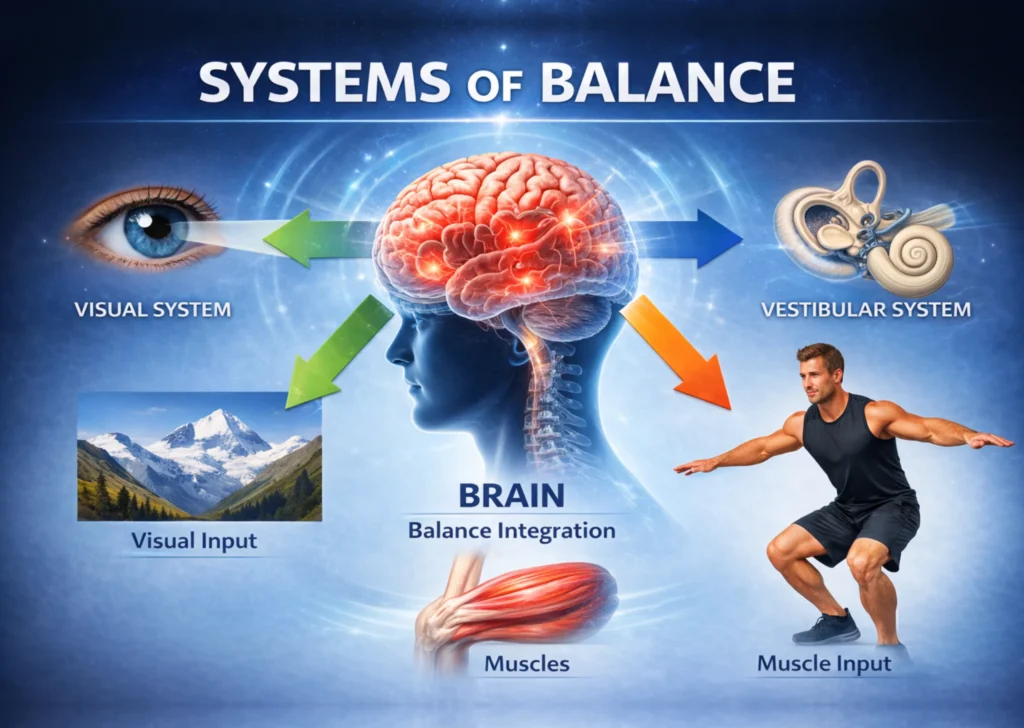
The balance and orientation system is a complex neurological network that has both a sensation system and a movement control system. The brain acts as a master controller/synthesizer. When it is working normally, we don’t feel it even though it is hard at work in all we do at all times, even when lying down or sitting still. It goes on high drive when we move or interact with our environment. This is a system that works on autopilot; we don’t perceive it, don’t have to direct it, or even know it is there. Until something goes wrong….
Then what we can feel is dizziness, spatial disorientation, blurred vision, nausea, brain fog, unsteadiness, feeling motion like on a boat, spinning, tilting, pulling, or floating. Balance system dysfunction creates uneasiness, anxiety, and in some cases a sense of panic or fear of falling. It can make your heart race, your body feel shaky, your neck tight, your eyes tired, your thoughts unclear, your words and speech slowed. Headaches can occur. It can be exhausting.
The neural super-highway of the balance system includes messages from our vision, our inner ear known as the vestibular system, and sensors from our body known as proprioception. These messages are constantly interpreted in our brain, which is the master controller of balance and orientation. The brain allows us to rapidly adjust to changes in our position, changes in our vision as motion occurs around us, and changes to the surfaces we walk on.
Vision: we align ourselves with visual cues in our environment through our peripheral visual system. We pick up motion in our peripheral vision to be alerted to things coming our way. When there is movement in our vision, our inner ear takes a bigger role in orienting our body to maintain balance and give the brain information about what our head is doing and where gravity is located. When we are using our vision to take in context while reading, watching any activity, looking for something, or speaking to someone, that central focus gives us the “what” content of the objects we are viewing. Simultaneously, our peripheral vision gives us the “where” content of spatial orientation to the floor, the walls, and the ceiling. Your brain is constantly seeing the where, even though we don’t pay attention to those visual signals. When the vestibular system is impaired, the brain uses both the what and the where to perceive motion, resulting in dizziness with reading, computer use, and watching TV. Dizziness can be created when driving or riding in a car, at the movies, or any time you move your eyes. The vestibular system also sets the position of the eyeballs in the socket, aligning the eye center with the bullseye intersection of the line of gravity with the horizon. When this alignment is off, you can get blurry or double vision.
Vestibular: we align ourselves with the vertical pull of gravity. We sense the acceleration of our head in space, the direction of acceleration or tilt of the head, and make adjustments with our eyes, our head, and our body to keep balance and spatial orientation. Our head makes adjustments on our body through inner ear-neck reflexes, our body makes adjustments through inner ear to torso and leg reflexes, our eyes make adjustments through inner ear to eye reflexes. Our vestibular system is the first to perceive change in position to allow our heart rate and blood pressure to regulate as we stand up. It also communicates with the emotional regulation center and the fight or flight center in the brain. When the vestibular system is impaired, we can experience dizziness (spinning, floating, rocking, tilting, lightheadedness), imbalance, wobbly, bouncing or blurring vision, nausea, racing heart rate, anxiety and panic.
Proprioception: we align ourselves with our surfaces through pressure. We align our head on our shoulders through sensors in the neck that are in constant communication with our inner ears. As we turn our head, these sensors communicate that position and motion to the brain. As we move on our feet, the pressure our feet make against the floor sends surface information to the brain so we can adjust our bodies correctly. The sensors in the neck send signals to the brain, communicating with vision and vestibular information to adjust our eye position and keep the body in balance as our neck moves.
In perfect harmony, we are in balance: physically and emotionally. In dysfunction, we are out of synch physically and emotionally. Vestibular Rehabilitation is the key to regaining harmony in the balancing superhighway of stability and integration of all the senses. Diet, exercise, sleep, nervous system regulation and optimization will aid in restoration and complete healing. An expert in vestibular recovery and brain optimization is a critical partner for the journey. You have an expert in NeuroBalance Physical Therapy.